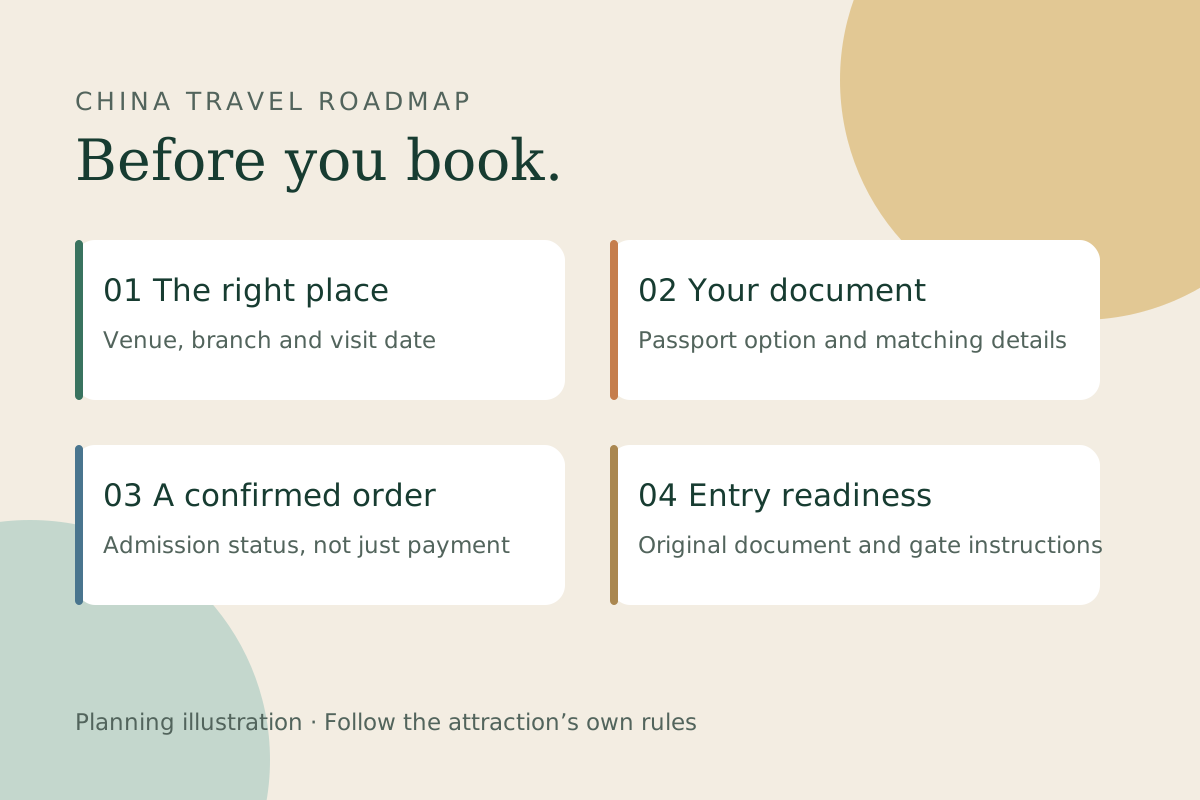
There is no single reservation rule for every museum, garden or scenic area in China. This guide gives you a repeatable checklist and a few official examples, not a universal promise that every foreign phone number or bank card will work.
Before you book: identify the exact product
| Check | What to record | Common mistake |
|---|---|---|
| Place | Official name, city and branch | Booking another museum branch |
| Visit | Date, entry session and closing notice | Treating an afternoon ticket as morning entry |
| Person | Passport document type and matching details | Selecting mainland identity card by default |
| Product | Admission, exhibitions and transport inclusions | Buying a shuttle without admission |
| Confirmation | Attraction order number and status | Keeping only a bank notification |
| Change of plan | Cancellation channel and cutoff | Assuming unused means refundable |
Open the official site yourself, rather than following an unsolicited message offering scarce tickets. Check the address and the destination of any booking link. Some operators link to outside booking providers; an external domain alone does not prove a scam, but an official link is stronger evidence than an advertisement claiming to be official.
Step 1: check whether a reservation is required
Do this before arranging the rest of the day around the attraction. Free admission does not necessarily remove a reservation requirement, and an ordinary museum entry rule may not cover a special exhibition.
For example, Shanghai's reservation announcement and museum guide distinguish ordinary individual visits at the People's Square museum from peak-period and exhibition exceptions. “Museums in China must always be booked” would therefore be poor advice.
At the other end of the spectrum, the Palace Museum publishes real-name booking instructions in its international visitor information and Chinese booking page. Use our dedicated Forbidden City guide for that particular visit instead of applying its rules to every attraction in Beijing. Older notices can remain on official sites; check current ticket instructions and dated closure notices together.
Step 2: use the passport option and matching details
Select passport / 护照 when that is your accepted travel document. Follow the form's instructions for family name, given names, spaces and document number. If a field refuses the details printed in your passport, stop and ask the operator how its form expects them; do not invent a Chinese ID number or book under another person's identity.
Check each traveler, including children, before payment. A purchaser's contact details and a visitor's identity can be separate fields. Being included in a family or group order does not mean every person can enter using the purchaser's document.
The Terracotta Warriors museum's visitor guide and ticket instructions explicitly discuss passport information and original-document checks. That supports a passport route for this venue, not an assertion that every Chinese booking form has the same interface.
Avoid sending full passport images through public comments or to an unverified seller. Our itinerary request form does not need your passport number or passport photograph. Identity information required for a ticket belongs in the verified operator's booking process.
Step 3: handle phone and payment problems separately
If a verification message does not arrive, check the country-code field, number format and the platform's current overseas-number instructions. A travel data connection does not itself prove you can receive an SMS on the number entered. Do not keep submitting a different number that you cannot access.
If login works but payment fails, check the order status before retrying. Use the provider's help channel or an alternative channel explicitly recognized by that attraction. Do not assume that arriving at a window will solve a sold-out date or that a hotel can obtain an exception.
The Chengdu Panda Base English ticket page names official and authorized channels; its Chinese ticket page provides corresponding booking guidance. Operator authorization is specific: a platform recognized for one attraction is not automatically authorized for another.
Our Alipay guide and WeChat Pay guide cover wallet preparation and limitations. A working shop payment still does not guarantee that a particular mini program will accept your account, document or card.
Step 4: verify the order after paying
Return to the attraction or seller's order screen. Look for the correct travelers, visit date, session, product and a confirmed status. Save the order reference and the actual entry instructions. If the screen says pending, processing or awaiting confirmation, treat that as unresolved rather than a confirmed admission.
If the bank shows a charge but the attraction has no confirmed order, save both records and contact the seller before paying again. Do not start a sequence of duplicate purchases hoping one will work. A refund or reversal can have a different timeline from the attraction's order update.
For bundled purchases, separate each component. At Mutianyu, admission and uphill rides are distinct choices; our Mutianyu day-trip guide explains what to check. For museums, identify whether an exhibition needs its own reservation even when general entry is available.
Step 5: prepare for entry and changes
Carry the original document used for booking unless the venue explicitly tells you otherwise, and save the confirmation offline. This is a preparation recommendation, not a claim that all venues use the same inspection method. Follow the attraction's actual gate instructions. Screenshots are useful backups but may not replace a required original document or a live code.
Check the specific entrance, not only the attraction's map pin. Allow time to reach the gate, clear any checks and solve a minor mismatch before the session cutoff. Opening time, last admission and closing time are three different concepts.
If plans change, use the original booking channel and read its terms before canceling. Different tickets in the same day may have different rules. Record the cancellation receipt; submitting a request is not the same as receiving money back. Do not assume that changing a hotel or flight automatically changes attraction bookings.
What to do if no suitable ticket is available
First decide whether the attraction is essential. If it is, look at another valid date before committing more non-refundable purchases. If it is not, use a nearby alternative that fits your interests and check that alternative's entry rules separately.
Do not buy a promise of identity-check bypass or “guaranteed entry” from an unknown person. A sensible itinerary can absorb one unavailable attraction. For practical examples, see our Shanghai three-day plan, Xi'an three-day plan and Chengdu three-day plan.
Planning help, without ticket brokerage
Our paid service is a human-reviewed English itinerary PDF for 2–8 days. We help organize the route and preparation decisions; we do not book tickets, obtain scarce inventory, handle passport verification or provide live entry support. View the sample or request a plan.
Source-based planning guidance, not a firsthand trip report or a booked service. Recheck venue notices for your travel dates. Editorial method and corrections.